Garage Door Spring Replacement
The spring does the real lifting — your opener just steers. When a spring snaps, the door becomes a 200-pound dead weight. Spring replacement is the single most common garage door repair in America, and a stocked local pro can usually fix it the same day.
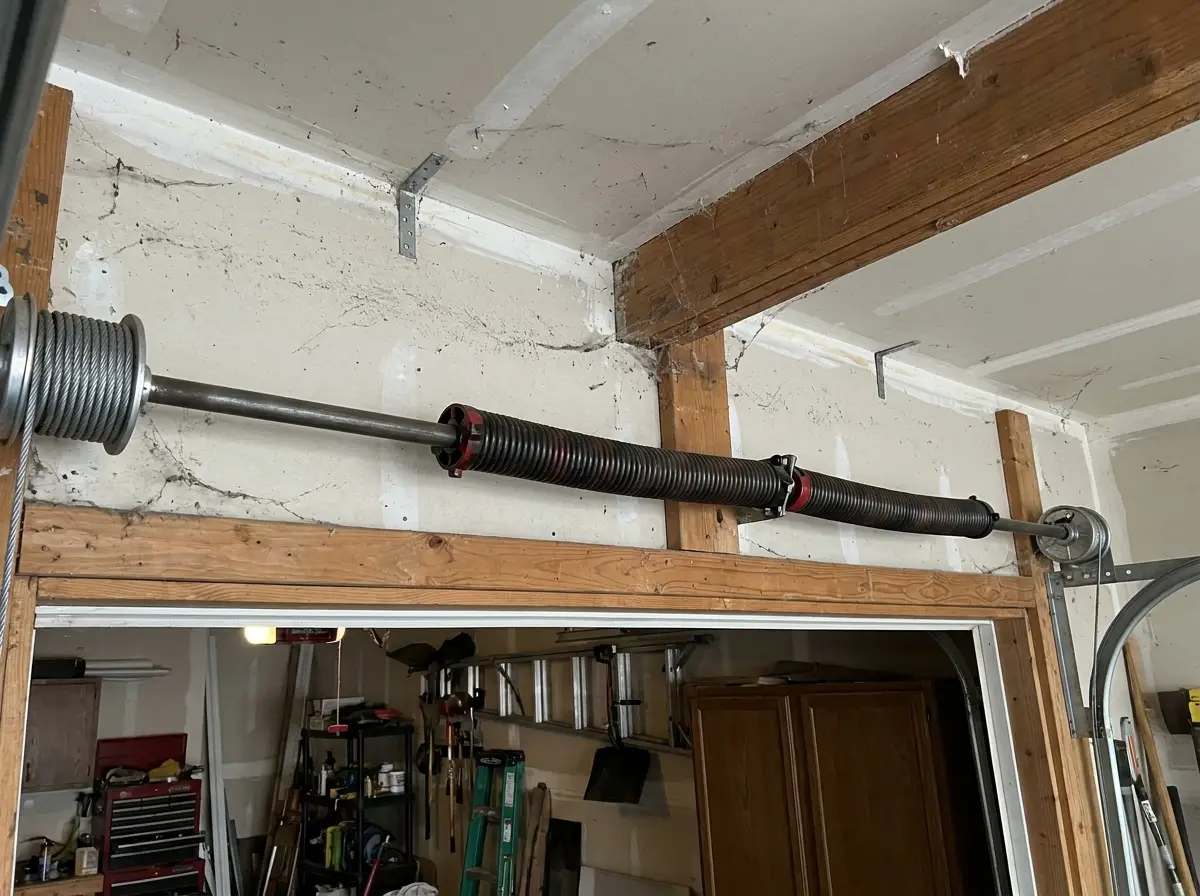
Torsion vs. extension springs
Torsion springs mount on a steel shaft above the door header and unwind to lift the door through cables and drums. They are standard on most doors installed since the 1990s, last longer, and lift more smoothly. Extension springs run along the horizontal tracks on each side and stretch to provide lift; they are common on older and lighter doors, and they must have safety cables threaded through them so a snapped spring can’t whip across the garage.
Spring life is rated in cycles — one cycle is one open-and-close. Builder-grade springs are rated 10,000 cycles, which sounds like a lot until you do the math: a family that uses the garage as the front door cycles it 6 to 10 times a day, which exhausts a 10,000-cycle spring in 3 to 5 years. High-cycle springs (25,000–50,000 cycles, sometimes oil-tempered or powder-coated) cost $30 to $80 more per spring and are usually the better buy.
Replace one spring or both?
On a two-spring torsion setup, replace both. The springs were installed together and have the same wear; when one breaks, the other has the same fatigue and typically fails within months. Replacing both in one visit costs $60 to $120 more than one spring; a second service call later costs the full trip charge plus labor again. Every honest technician will tell you the same thing — this is not an upsell.
What spring replacement costs
National averages: a single torsion spring replaced runs $150 to $290 all-in; both springs on a double door $200 to $450; extension spring pairs $130 to $250. The spread comes from spring size (heavier insulated doors need bigger wire), cycle rating, and local labor rates — see your city page for local ranges.
The parts themselves are cheap relative to the visit — a standard torsion spring wholesales for $20 to $50 — so be skeptical of quotes above $500 for a standard residential double door, and equally skeptical of $89 "complete spring replacement" ads, which classically convert to a $700 invoice through invented add-ons once the truck is in your driveway.
Why springs break (and how to make the next set last)
Steel fatigue is the main cause — every cycle flexes the coil until it cracks, and cold snaps concentrate failures because steel is more brittle at low temperatures, which is why repair companies’ phones ring most the first freezing morning of the year. Rust accelerates fatigue: a light coat of garage-door-rated lubricant on the coils once or twice a year measurably extends life. Humid coastal climates and unsealed garages chew through unprotected springs fastest.
The other quiet killer is an unbalanced door. If a previous repair installed the wrong-size spring, the spring works outside its design range and fails early — another reason to use a pro who sizes springs by door weight, height, and track radius rather than just matching what was there.
Both springs replaced on a standard double door, parts and labor. Single doors and single-spring jobs run lower. See your city’s page for local price ranges.
Spring Replacement — Common Questions
Can I use my garage door with a broken spring?
No — and don’t run the opener. With a broken spring the opener is dragging the door’s full dead weight, which strips the drive gear, bends the top door section, and can snap the door out of its tracks. If you must get a car out, pull the emergency release and lift manually with a helper, then leave the door down until it’s repaired.
How long does spring replacement take?
For a technician with the right springs on the truck, 45 minutes to an hour for a standard double-door torsion job, including rebalancing the door, lubricating hardware, and resetting opener travel limits. Unusual sizes or rusted-solid hardware can stretch the job, but it remains a single-visit repair in nearly all cases.
What are high-cycle springs and are they worth it?
High-cycle springs use thicker or longer coils rated for 25,000 to 50,000 cycles instead of the builder-standard 10,000. The upgrade typically adds $30 to $80 per spring. If you cycle the door more than a few times a day — most families do — the upgrade roughly triples spring life for a 20–30% higher part cost, making it one of the few genuinely worthwhile upsells in this trade.
Why did my spring break in cold weather?
Spring steel becomes more brittle as temperature drops, so an aging coil that survived all summer cracks on the first hard freeze. Cold also thickens old grease and stiffens rollers, raising the force on the spring. If you’re in a cold-winter metro, fall is the smart time for a tune-up — a balanced, lubricated door takes meaningfully less spring stress into winter.
My door has only one spring — is that wrong?
Not necessarily. Many single-car doors and some lighter double doors are engineered for one torsion spring. But if a double door originally had two springs and someone replaced only the broken one, leaving a mismatched old spring on the shaft, the door will be out of balance and hard on the opener. A technician can tell in minutes by testing the door’s balance by hand.
Spring Replacement Where You Live
Local pricing, local conditions, and a vetted pro for your area:
- Spring Replacement in Chicago, IL
- Spring Replacement in Houston, TX
- Spring Replacement in Phoenix, AZ
- Spring Replacement in Dallas–Fort Worth, TX
- Spring Replacement in Charlotte, NC
- Spring Replacement in Denver, CO
- Spring Replacement in Atlanta, GA
- Spring Replacement in Mesa, AZ
- Spring Replacement in Miami, FL
- Spring Replacement in Aurora, CO
- Spring Replacement in Plano, TX
- Spring Replacement in Chandler, AZ
- Spring Replacement in Gilbert, AZ
- Spring Replacement in Frisco, TX
- Spring Replacement in McKinney, TX
- Spring Replacement in Fort Lauderdale, FL
- Spring Replacement in Naperville, IL
- Spring Replacement in Pearland, TX
- Spring Replacement in Pompano Beach, FL
- Spring Replacement in Sugar Land, TX
- Spring Replacement in Alpharetta, GA
- Spring Replacement in Huntersville, NC
- Spring Replacement in Marietta, GA
- Spring Replacement in Katy, TX
Ready to get it fixed?
One free call connects you with a vetted local garage door pro.