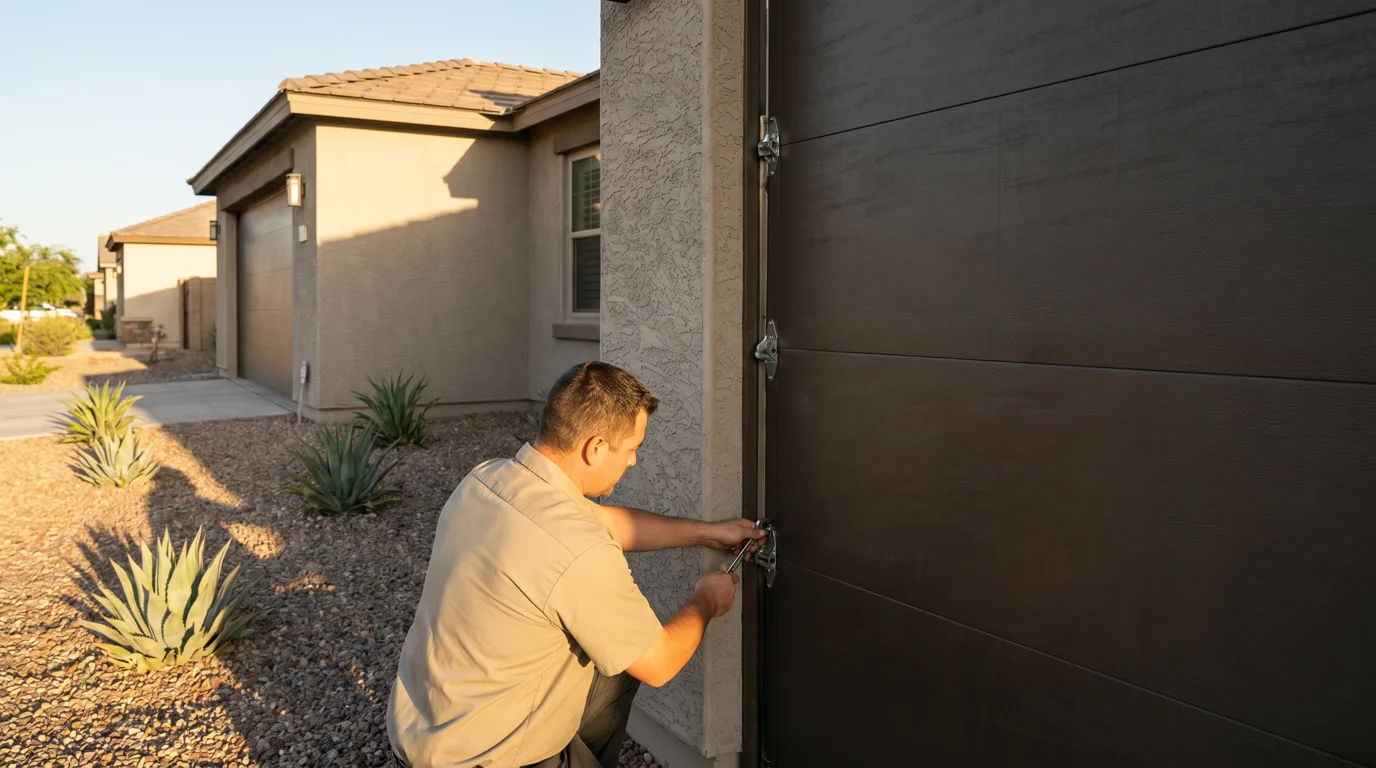
Garage Door Repair & Replacement in Mesa, AZ
Same-day service from vetted, local Mesa garage door pros — springs, openers, off-track doors, and new installations, quoted upfront.
- Local Mesa pros, vetted & insured
- Price approved by you before any work
- 24/7 emergency response
Request Service — Free Quote
A vetted local pro in Mesa calls you back — usually within 15 minutes during business hours.
Mesa is Arizona's third-largest city and the East Valley's garage door workhorse market — half a million residents spread from 1970s–80s neighborhoods like Dobson Ranch and Mesa Grande to brand-new master-planned growth at Eastmark and the Elliot Road tech corridor. That spread gives Mesa techs both ends of the trade in a single day: forty-year-old hardware with obsolete spring sizes in the older west-side stock, and builder-grade 2015–2022 doors at Eastmark just starting their first failure wave.
The desert is the constant. Mesa's west-facing doors hit surface temperatures above 160°F in July, baking lubricant off springs, flattening cheap nylon rollers, and cooking opener capacitors and logic boards years ahead of schedule — openers fail before springs in the East Valley more than almost anywhere. Monsoon season adds the haboobs: dust walls roll across Mesa every summer and pack abrasive grit into tracks, roller bearings, and photo-eye lenses, producing the Valley's signature post-storm wave of 'door won't close' calls that turn out to be dirty sensors.
Mesa also has a retiree dimension: the city's active-adult communities (Leisure World, Sunland, Dreamland Villa) run high on single-car and golf-cart doors, low-headroom retrofits, and homeowners who want a tech who shows up on time and explains the work. The companies in our Mesa network are fluent in both worlds.
Garage Door Services in Mesa
Repair in Mesa
A garage door that won’t open, won’t close, or makes grinding noises is more than an inconvenience — it’s a se…
Learn more →Spring Replacement in Mesa
The spring does the real lifting — your opener just steers. When a spring snaps, the door becomes a 200-pound…
Learn more →Opener Repair in Mesa
When the remote clicks and nothing happens, the problem may be a $15 sensor alignment or a worn-out motor — an…
Learn more →Installation in Mesa
A new garage door is consistently ranked the single highest-ROI home improvement in Remodeling Magazine’s Cost…
Learn more →Commercial Repair in Mesa
A failed overhead door doesn’t just block a bay — it stops trucks, idles crews, and leaves inventory exposed.…
Learn more →24/7 Emergency in Mesa
A garage door stuck wide open at 11 PM is an open door to your home. A car trapped behind a dead door at 6 AM…
Learn more →Every Mesa Pro Is Vetted Before They Reach Your Door
Insurance Verified
Active general liability coverage confirmed before joining our network — and rechecked periodically.
Licensed Where Required
State and city contractor licensing verified wherever the jurisdiction requires it.
Upfront Pricing Required
Every pro quotes the price on-site, in writing, before work begins. Bait-and-switch ends the partnership.
Track Record Reviewed
Years in business, review history, and complaint patterns checked under one consistent company name.
Garage Door Service Costs in Mesa
Typical all-in price ranges (parts + labor) reported in the Mesa area. Your exact quote depends on door size, parts, and access — the technician confirms the price before any work begins.
| Service | Typical Mesa Range | Notes |
|---|---|---|
| Garage Door Repair | $145 – $420 | Post-haboob sensor/track cleaning calls are a Mesa staple |
| Garage Door Spring Replacement | $170 – $375 | Ask for high-temp lubrication with every spring job |
| Garage Door Opener Repair | $100 – $675 | Heat kills openers first here; replacement often beats repair past 10 years |
| Garage Door Installation | $1,200 – $4,600 | Insulated doors drop Mesa garage temps 15–20°F |
| Commercial Garage Door Repair | $270 – $1,300 | Falcon Field and Elliot Road corridor commercial coverage |
| 24 Hour Emergency Garage Door Repair | $195 – $590 | After-hours premium typically $75–125 |
Want an exact number for your door?
Free quote over the phone in minutes — confirmed on-site before any work.
Garage Door Replacement & New Installation in Mesa
When a door is past saving — rusted-through sections, repeated spring and cable failures, or panels that no longer exist as replacement parts — our Mesa pros measure, quote, and install new doors, usually within one to two weeks. A new garage door installed in Mesa typically runs $1,200–$4,600 depending on size, material, and insulation. The install price is quoted in writing before any work is scheduled, and the old door is hauled away as part of the job.
Not sure whether to fix or replace? Our guide to repair vs. replacement walks through the five factors that decide it, and the installation service page covers door styles, materials, and what's included in every install.
What Mesa Weather Does to Garage Doors
Sonoran Desert extremes shared with the whole Valley: 110°F-plus summers with garage interiors past 125°F, intense year-round UV, and June–September monsoons whose haboob dust storms pack grit into every moving part — Mesa's east-side position puts it directly in the path of storms rolling in from the southeast. Winters are mild; corrosion is minimal in the dry air.
Dry heat changes the failure mode: rust is rare, but baked-off lubricant leaves coils cycling dry and sustained high temperatures accelerate metal fatigue. Twice-yearly lubrication with high-temperature product is the local rhythm, and opener electronics — not springs — are usually the first major casualty in Mesa garages.
Mesa Homes & Garages
The Valley's widest age spread: 1970s–80s ranch stock in Dobson Ranch, Mesa Grande, and the west side (legacy hardware, some original one-piece doors), 1990s–2000s sections through the center, and the 2015+ Eastmark/Cadence boom in the southeast now exiting builder-spring life. Active-adult communities add single-car, golf-cart, and low-headroom doors. HOAs are common but generally less restrictive than Scottsdale's.
Permits & Local Rules
Arizona's ROC contractor licensing applies: any garage door job above the $1,000 handyman exemption — essentially every installation — legally requires a Registrar of Contractors license, verifiable free at azroc.gov. The City of Mesa doesn't require a permit for like-for-like residential door replacement. Mesa's HOAs typically review visible style changes but are generally quicker than Scottsdale's design boards; active-adult communities often have their own architectural rules worth checking before a style change.
Mesa Neighborhoods We Serve
- Dobson Ranch
- Eastmark
- Las Sendas
- Red Mountain Ranch
- Superstition Springs
- Alta Mesa
- Lehi
- Mesa Grande
- Augusta Ranch
- Leisure World
Surrounding Communities
- Gilbert
- Chandler
- Tempe
- Apache Junction
- Queen Creek
Serving Maricopa County and surrounding areas.
Garage Door Questions from Mesa Homeowners
After every dust storm my door refuses to close. Is something actually broken?
Almost certainly not — this is the East Valley's most common service call. Haboob dust coats the photo-eye sensor lenses near the floor, and the opener reads the haze as an obstruction and refuses to close. Wipe both lenses with a soft dry cloth and check that both LEDs glow steadily. If it keeps happening, dust has worked into the sensor brackets or track rollers, and a cleaning-and-alignment visit ($75–150) sorts it properly.
Why do garage door openers die so young in Mesa?
Heat. The opener lives at the garage ceiling where summer air stratifies hottest — 125–135°F for hours daily — and electrolytic capacitors and logic boards age roughly twice as fast under that load. A unit rated for 12–15 years commonly fails at 7–9 in an uninsulated Mesa garage. Buying a quality opener, insulating the door, and keeping the door balanced so the motor isn't straining are the practical life-extenders.
My Eastmark home was built in 2017 and the spring just snapped. Already?
On schedule. Builder-grade springs are rated 10,000 cycles; a family cycling the door 6–8 times a day exhausts that in 5–7 years, and Eastmark's big 2015–2020 cohorts are entering their failure wave now. Replace both springs (the survivor has identical fatigue) and step up to high-cycle coated coils for $60–160 more — it roughly triples the interval and ends the every-six-years cycle.
I'm in Leisure World — can you handle our community's door rules and golf-cart doors?
Yes. Mesa's active-adult communities are a regular part of the route: single-car and golf-cart doors, low-headroom track retrofits, and each community's architectural rules for visible changes. Techs serving these communities daily carry the smaller spring sizes and hardware these doors use, quote in writing before working, and are used to scheduling around community gate procedures.
How do I verify a Mesa garage door company is legitimate?
Arizona makes it easy: look the company up at azroc.gov — the Registrar of Contractors database is free and searchable. Any installation over $1,000 legally requires an ROC license, and legitimate Valley companies print their ROC number on trucks and invoices. No ROC number on a full-door quote is a hard stop. Beyond that: verified insurance, a physical Valley address, and consistent reviews under one name.
Helpful Reading for Mesa Homeowners
Garage door trouble in Mesa?
One free call. A vetted local pro. Usually fixed the same day.
Garage Door Service Near Mesa
We also connect homeowners with local pros in these nearby areas:
Page last updated: 2026-07-02