Garage Door Opener Repair & Replacement
When the remote clicks and nothing happens, the problem may be a $15 sensor alignment or a worn-out motor — and it takes a trained eye about ten minutes to know which. We connect you with local techs who service every major opener brand: LiftMaster, Chamberlain, Genie, Craftsman, Linear, and more.
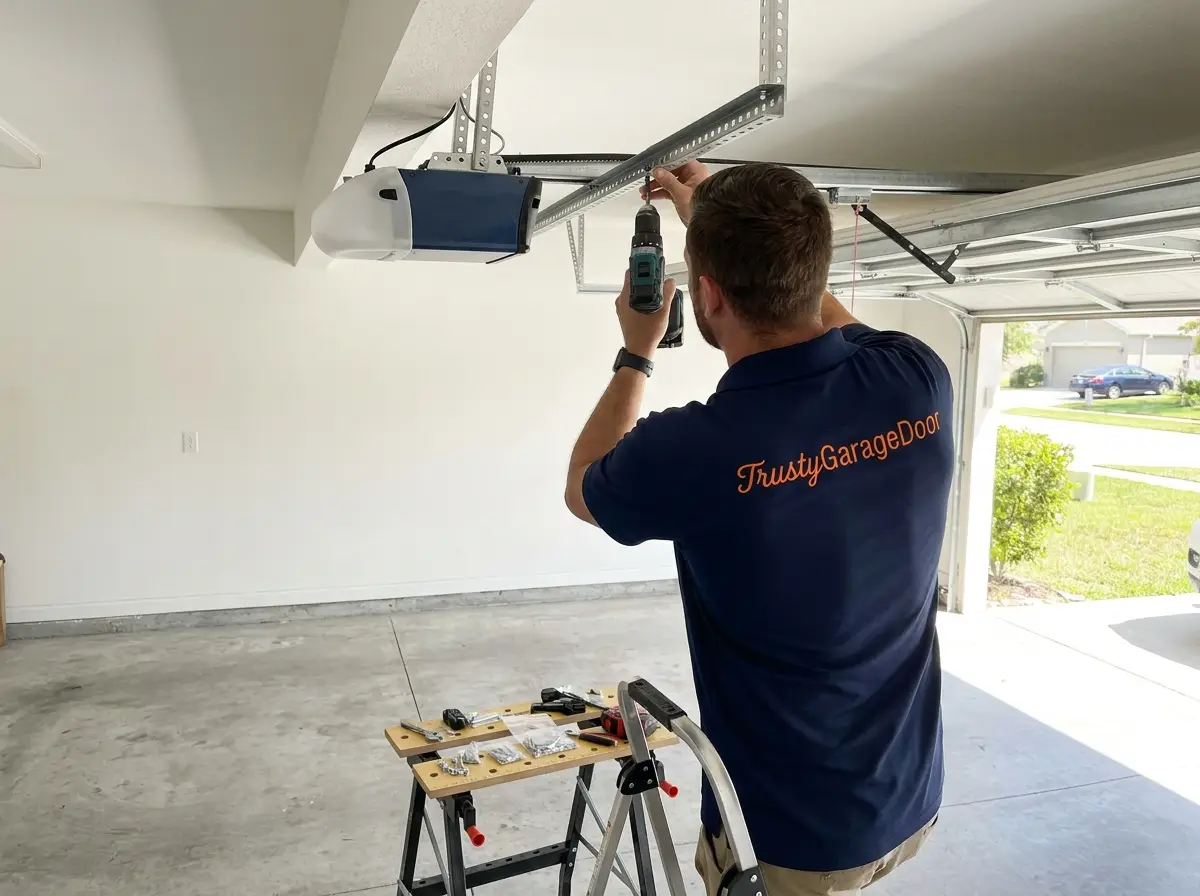
Repair or replace? The 10-year rule
Openers have a practical service life of 10 to 15 years. Under 10 years old, most failures — stripped drive gears, worn trolleys, misaligned safety sensors, bad logic boards under warranty — are worth repairing at $100 to $250. Past 12 years, a major failure usually tips the math toward replacement: parts for discontinued models get scarce, and pre-1993 units lack the photo-eye safety reversal system that federal law (UL 325) has required since then. If your opener predates safety sensors, replace it regardless of whether it still runs.
Replacement also buys real upgrades: belt drives that are quiet enough for bedrooms above the garage, battery backup (required by law in some states for new installs, and invaluable anywhere with storm outages), Wi-Fi control with open/close alerts on your phone, and rolling-code security that ended the era of code-grabbing burglary.
Common opener problems
Most opener service calls fall into a few buckets:
- Door reverses before closing or won’t close at all — photo-eye sensors blocked, dirty, or knocked out of alignment. The most common opener call, and one of the cheapest.
- Motor runs but the door doesn’t move — stripped main drive gear (classic on older chain units) or a broken trolley/carriage.
- Remote works only at point-blank range — dying remote battery, or interference; LED bulbs in the opener are a notorious RF interference source.
- Opener is loud, jerky, or shakes the ceiling — worn chain, failing motor capacitor, or the door itself is out of balance and overloading the motor.
- Keypad or remotes stopped pairing — logic board reset or replacement, sometimes just a re-programming visit.
- Door opens by itself — stuck wall-button wiring, a neighbor’s frequency overlap on very old units, or a failing board. Worth resolving quickly for security.
Chain vs. belt vs. wall-mount (jackshaft)
Chain drives are the workhorses — cheapest, durable, but noisy; fine for detached garages. Belt drives use a steel-reinforced rubber belt, cost $50 to $100 more, and are the right call when bedrooms or offices sit above or beside the garage. Wall-mount jackshaft openers bolt beside the door and drive the torsion shaft directly: they free the ceiling, eliminate rail vibration entirely, and shine in tall or cluttered garages, at a $150 to $300 premium over a belt unit.
Whatever the drive, motor sizing matters less than marketing suggests — a properly balanced residential door needs only 1/2 HP equivalent. If a tech says you need a bigger motor because the door is heavy, the door’s springs need adjusting; the motor was never meant to do the lifting.
What opener work costs
Typical national ranges: sensor realignment or replacement $75 to $175; drive gear and sprocket rebuild $150 to $250; logic board $150 to $300; trolley or chain/belt replacement $130 to $220. A new opener installed — unit plus labor plus haul-away — runs $350 to $550 for a quality chain drive, $400 to $650 for belt drive with Wi-Fi, and $550 to $850 for wall-mount jackshaft models. Battery backup adds $50 to $100.
Repairs from ~$100–$250; full opener replacement installed typically $350–$700 depending on drive type and features. See your city’s page for local price ranges.
Opener Repair — Common Questions
Why does my garage door reverse before it touches the floor?
Two usual suspects. If it reverses and the opener light flashes, the photo-eye sensors near the floor are blocked, dirty, or misaligned — wipe the lenses and check that both LEDs glow steadily. If the eyes are fine, the close-travel limit or force setting needs adjustment, which is a dial or menu setting on the opener head. Both are quick fixes for a tech, and the sensor check is safe to try yourself.
Is it worth repairing a 15-year-old opener?
Usually not, unless the fix is trivial. At 15 years you’re past the design life, replacement parts are drying up, and you’re missing a decade of safety and security improvements — battery backup, rolling-code remotes, smartphone alerts. Put the $200 repair money toward a $400–$650 new unit with a fresh warranty instead.
Can I replace just the remote instead of calling someone?
Often yes. Universal remotes ($20–$40) pair with most openers made after 1993 — you press the "learn" button on the opener head and then the remote button. If the opener won’t enter learn mode or remotes keep losing their pairing, the logic board’s radio receiver is failing and that’s a service visit.
What is battery backup and do I need it?
A battery in the opener that gives you roughly 20 open/close cycles during a power outage. California requires it on all new opener installs (SB-969, after garage doors trapped cars during wildfire evacuations), and it’s strongly recommended in any storm- or hurricane-prone metro. Retrofit battery-backup units add about $50 to $100 to a replacement.
My opener works but is extremely loud. Do I need a new one?
Not necessarily — first have the door itself checked. Worn steel rollers, dry hinges, and an out-of-balance door make any opener sound terrible, and a $130–$220 roller-and-tune-up visit often transforms the noise. If the racket is from the unit itself (grinding gearbox, rattling chain), and it’s over 10 years old, a belt-drive replacement is the lasting fix.
Opener Repair Where You Live
Local pricing, local conditions, and a vetted pro for your area:
- Opener Repair in Chicago, IL
- Opener Repair in Houston, TX
- Opener Repair in Phoenix, AZ
- Opener Repair in Dallas–Fort Worth, TX
- Opener Repair in Charlotte, NC
- Opener Repair in Denver, CO
- Opener Repair in Atlanta, GA
- Opener Repair in Mesa, AZ
- Opener Repair in Miami, FL
- Opener Repair in Aurora, CO
- Opener Repair in Plano, TX
- Opener Repair in Chandler, AZ
- Opener Repair in Gilbert, AZ
- Opener Repair in Frisco, TX
- Opener Repair in McKinney, TX
- Opener Repair in Fort Lauderdale, FL
- Opener Repair in Naperville, IL
- Opener Repair in Pearland, TX
- Opener Repair in Pompano Beach, FL
- Opener Repair in Sugar Land, TX
- Opener Repair in Alpharetta, GA
- Opener Repair in Huntersville, NC
- Opener Repair in Marietta, GA
- Opener Repair in Katy, TX
Ready to get it fixed?
One free call connects you with a vetted local garage door pro.