Commercial Garage Door Repair
A failed overhead door doesn’t just block a bay — it stops trucks, idles crews, and leaves inventory exposed. We connect warehouses, auto shops, fire stations, storage facilities, and storefronts with commercial door companies that stock heavy-gauge parts and offer priority response for businesses.
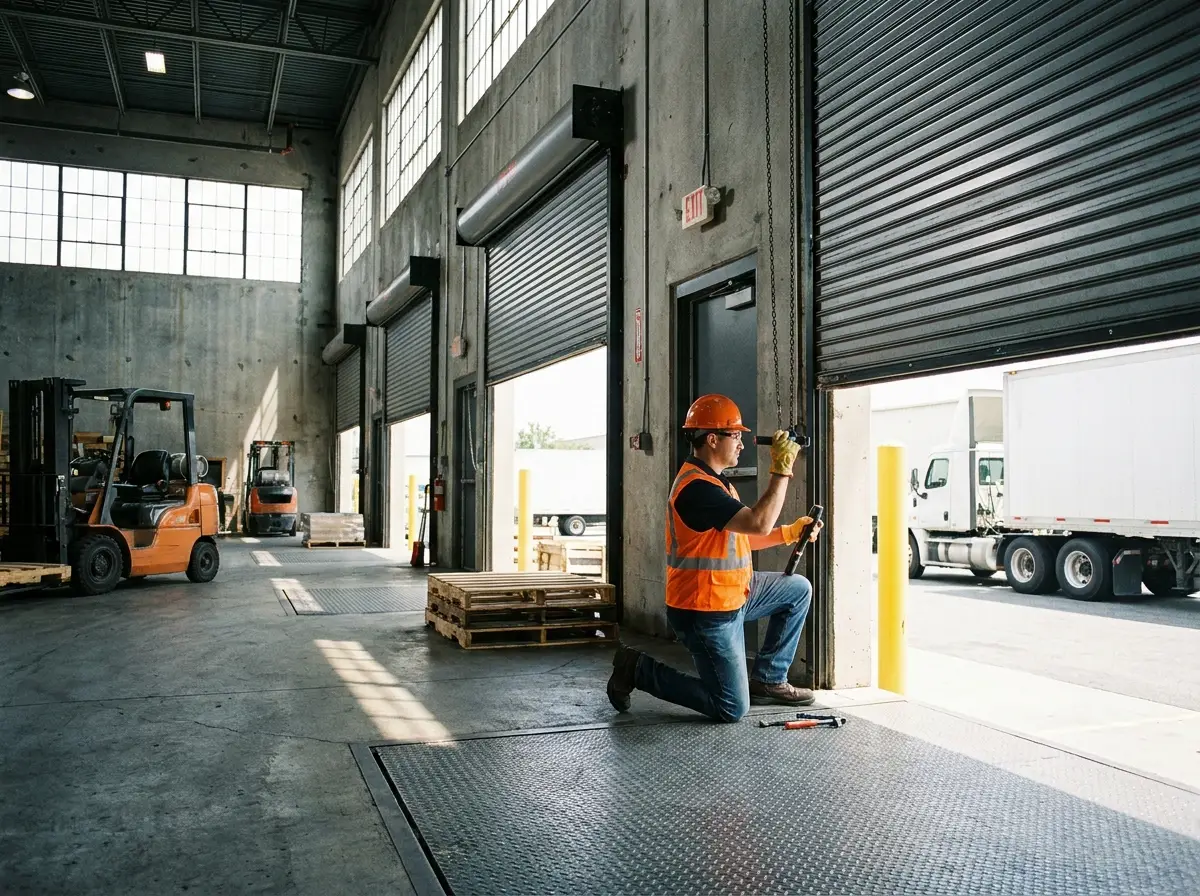
Commercial door types we cover
Commercial overhead doors differ from residential in scale, duty cycle, and code requirements:
- Sectional steel doors — the warehouse and firehouse standard; insulated and non-insulated, often 12 to 20 feet tall.
- Rolling steel / coiling doors — interlocking slats coiling above the opening; the choice for storefronts, parking garages, and security closures.
- High-speed fabric and rubber doors — for climate control and traffic flow in food, pharma, and logistics facilities.
- Fire-rated rolling doors — required at fire separations; NFPA 80 mandates an annual drop test by a qualified technician, with documentation.
- Dock levelers, seals, shelters, and vehicle restraints — the loading-dock package that fails as hard as the doors do.
- Security grilles and counter shutters — retail closures and service-counter doors.
Why commercial doors fail differently
Duty cycle is the whole story. A residential door runs 1,500 cycles a year; a busy distribution bay can run that in two weeks. Commercial torsion springs are sized accordingly — 25,000 to 100,000+ cycle ratings — and operators are three-phase or heavy single-phase units with chain hoists and interlocks. When a facilities manager replaces commercial springs with whatever a residential supplier had on the shelf, the replacement fails in months. Use companies that actually stock commercial-gauge springs, slats, and operator parts.
Forklift and truck strikes are the other big category. A struck track or bent guide on a rolling door is not cosmetic: it loads the curtain unevenly and accelerates failure. Most commercial door companies offer panel, slat, and guide replacement, and the good ones will tell you when a strike-damaged door is safe to run temporarily and when it must be locked out.
Planned maintenance saves bays
Almost every commercial operator in our network offers planned maintenance agreements: scheduled inspections (typically quarterly or semi-annual) covering spring tension, cable wear, operator limits, safety edges, photo eyes, and — for fire doors — the NFPA 80 drop test with the paperwork your fire marshal and insurer want to see. For a facility with more than a couple of doors, a PM agreement consistently costs less than one emergency call with a bay down, and it converts door failures from emergencies into line items.
Response and pricing for businesses
Commercial calls are dispatched with priority because downtime is measured in dollars per hour. Typical ranges: commercial spring replacement $300 to $900 depending on door size and cycle rating; operator repair $250 to $700, replacement $1,500 to $4,000 installed; rolling steel slat or guide repair $400 to $1,500; dock leveler service from $300. Expect a real quote after an on-site assessment — commercial doors vary too much for honest phone pricing — and ask about after-hours rates up front if you run multiple shifts.
Commercial repairs vary widely with door type and size; spring and operator work on standard sectional doors sits at the low end, rolling steel and dock equipment higher. See your city’s page for local price ranges.
Commercial Repair — Common Questions
Do you handle after-hours and weekend commercial calls?
Yes — most commercial door companies in our network run on-call technicians for after-hours emergencies, because warehouses and parking structures don’t fail on a schedule. After-hours rates typically run 1.5x to 2x standard labor. If a door failure has a bay open to the street or a vehicle trapped, say so when you call; those are treated as immediate dispatches.
What is an NFPA 80 fire door drop test and do I need one?
If your building has fire-rated rolling doors at fire separations, NFPA 80 requires a full drop test annually — the door must close completely under fusible-link/governor control and then be reset by a trained tech, with the test documented. Fire marshals and insurers ask for the records. It is absolutely not a maintenance task for in-house staff without training; a botched reset can destroy the door’s governor.
Our door was hit by a forklift. Can it be repaired or is it totaled?
Often repairable. Sectional doors take individual panel replacement well if the tracks survived; rolling steel doors can have individual slats and bent guides replaced. The judgment call is the spring shaft and operator alignment — a competent commercial tech will assess whether the door is safe to operate while parts are ordered or needs to be locked out. Get photos and the assessment in writing for your insurance claim.
Can you service our roll-up storage unit doors?
Yes — self-storage roll-up doors (mini-storage curtains) are a standard commercial item: tension adjustment, new springs, bottom bars, latches, and full curtain replacement. Facilities with dozens of units typically negotiate per-door pricing on a planned maintenance agreement, which is far cheaper than one-off calls every time a tenant reports a heavy door.
Do the companies carry commercial insurance for work at our facility?
The commercial operators we refer carry general liability appropriate for commercial work, and most can produce a certificate of insurance (COI) naming your company or property manager as certificate holder before work begins — just ask the dispatcher when booking. If your facility requires specific endorsements or background-checked techs, raise it on the first call so the right company is matched.
Commercial Repair Where You Live
Local pricing, local conditions, and a vetted pro for your area:
- Commercial Repair in Chicago, IL
- Commercial Repair in Houston, TX
- Commercial Repair in Phoenix, AZ
- Commercial Repair in Dallas–Fort Worth, TX
- Commercial Repair in Charlotte, NC
- Commercial Repair in Denver, CO
- Commercial Repair in Atlanta, GA
- Commercial Repair in Mesa, AZ
- Commercial Repair in Miami, FL
- Commercial Repair in Aurora, CO
- Commercial Repair in Plano, TX
- Commercial Repair in Chandler, AZ
- Commercial Repair in Gilbert, AZ
- Commercial Repair in Frisco, TX
- Commercial Repair in McKinney, TX
- Commercial Repair in Fort Lauderdale, FL
- Commercial Repair in Naperville, IL
- Commercial Repair in Pearland, TX
- Commercial Repair in Pompano Beach, FL
- Commercial Repair in Sugar Land, TX
- Commercial Repair in Alpharetta, GA
- Commercial Repair in Huntersville, NC
- Commercial Repair in Marietta, GA
- Commercial Repair in Katy, TX
Ready to get it fixed?
One free call connects you with a vetted local garage door pro.